Table Of Content
To help recovery, you can also apply a warm compress and take medication as needed for inflammation. If you notice signs of infection or your ingrown hair is irritating you, talk to a healthcare provider about possible further treatment. If you get ingrown hairs frequently, you may want to consider a long-term solution, such as laser hair removal. Or, you can take preventative steps like shaving differently or using a razor with just one blade.
How is an ingrown hair treated?
Chemical depilatories like Neet or Nair can loosen the structure of hair, resulting in blunt tips of shaved hairs at the follicular opening. Chemical depilatories may be used every second or third day rather than every day to avoid chemical irritation on the skin. Hydrocortisone cream can be applied to alleviate the irritation caused by chemical depilatories. Overall, teenagers and adults are more prone to ingrown hairs. African-American individuals with thicker, coarser tightly curling hairs tend to have the highest rate of problems with ingrown hairs. People with high levels of certain sex hormones can have more hair than usual.
ACD A-Z of Skin - Pseudofolliculitis Barbae
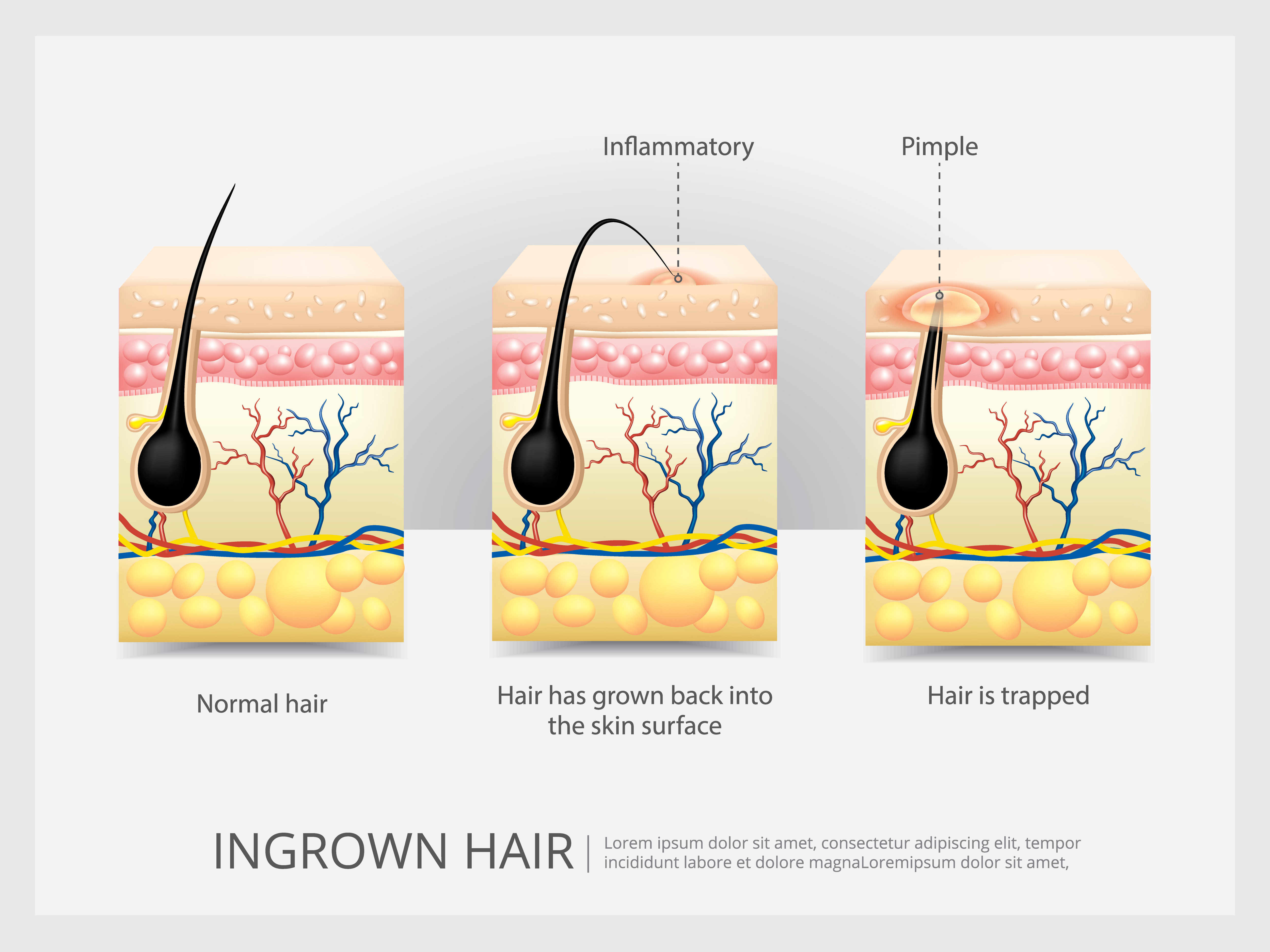
Signs of ingrown hairs include bumps that appear like acne, tenderness, redness, and itching. After healing, ingrown hairs can leave behind keloids (scarring) and areas of hyperpigmentation (skin discoloration). An infected ingrown hair — also known as folliculitis — typically looks like a bump, a hard lump, or a cyst under the skin. Sometimes, dead skin can clog a hair follicle, which forces the hair to grow sideways under your skin rather than up and out. If you cut naturally curly hair too short, the sharpened end of the hair can pierce your skin, causing an ingrown hair.
How do you get rid of an ingrown hair cyst?
First and foremost, you should only release ingrown hairs that you can visibly see beneath the surface of the skin. More importantly, you should never pop a pus-filled bump or try to dig out an ingrown hair. Because the hair of the beard and pubic area tends to be coarse, these areas are particularly vulnerable to penetration by ingrown hairs.
Man left in coma on life support after an ingrown HAIR on his groin turned into deadly sepsis - Daily Mail
Man left in coma on life support after an ingrown HAIR on his groin turned into deadly sepsis.
Posted: Wed, 20 Mar 2024 07:00:00 GMT [source]
They may recommend a more permanent hair removal method, like laser hair removal or electrolysis, she says. And if you develop a red bump and are unsure about its diagnosis, see a medical professional before attempting to treat or diagnose it at home. After you shave, apply a product made with BHAs to close the hair follicles that opened after being exposed to warm water, Weinstein says. Doing so prevents bacteria or dirt from getting into the follicles. This chemical exfoliant from Paula’s Choice has salicylic acid (a BHA) and green tea extract to calm redness, according to the brand. The formula is lightweight and feels refreshing on my skin when I apply it using a cotton pad.
Masks Strongly Recommended but Not Required in Maryland, Starting Immediately
Curly hair is more likely to bend back and reenter your skin, especially after it's been shaved or cut. Exfoliating your skin removes a dead layer of skin cells and helps release ingrown hairs. Use warm — not hot — water and small, circular motions to wash your affected areas with a washcloth, exfoliating brush or exfoliating gel or scrub. In rare cases, your healthcare provider may use a sterile surgical knife with a thin blade (scalpel) to make a small cut in your affected areas. They’ll squeeze out any pus and use sterile tweezers to remove the ingrown hair. If an ingrown hair becomes infected, you may notice the bumps getting bigger and more painful.
Apply rubbing alcohol to your surrounding skin to prevent an infection. Then, carefully thread the sterile needle, pin or tweezers through the exposed hair loop. Gently lift the hair loop until one end releases from your skin. An ingrown hair looks like a raised, discolored spot on your skin. It’s a strand of hair that grows back into your skin after shaving, tweezing or waxing.
Never pick or pop an infected ingrown hair, as this also increases the risk of complications. Ingrown hairs are most common in areas of hair removal, such as the face, legs, armpits, and pubic region. Shaving and waxing creates sharper hairs that tend to get trapped in the skin.
Transfollicular penetration can occur if you stretch your skin while shaving. They can figure out the type of cyst it is and drain it or remove it. Removing a hair can also cause the new hair that grows in its place to grow incorrectly. Your new hair may grow sideways and eventually curl back down. If you notice one or more of these symptoms, see a physician or health professional for help as soon as possible.
If the ingrown hair is causing significant irritation or pain, you can apply a topical corticosteroid once or twice a day for three to four weeks to reduce the inflammation. If the bump is very inflamed and large in size, a healthcare provider may recommend a corticosteroid injection. Your health care provider might recommend laser-assisted hair removal, which removes hair at a deeper level than does shaving, waxing, tweezing or electrolysis. Laser treatment slows regrowth and is a longer term solution. Possible side effects of this method are blistering, scarring and loss of skin color (dyspigmentation). You should consult a dermatologist about ingrown hairs if you get them persistently or if you get many in one area, Chang says.
An infected ingrown hair happens when a hair is blocked from leaving the skin or newly emerged hair curls back into the skin, and the follicle becomes infected. An ingrown hair can lead to a localized foreign-body inflammatory reaction, which causes pinpoint red or pink bumps on the skin. Hair structure and direction of growth play a role in ingrown hair. A curved hair follicle, which produces tightly curled hair, is believed to encourage the hair to reenter the skin once the hair is cut and starts to grow back. Shaving creates a sharp edge on hair, making it easier to pierce the skin.
Over-the-counter (OTC) medications containing benzoyl peroxide or retinoids can reduce inflammation and decrease the size of your razor bumps or ingrown hair cysts. Laser hair removal may be an option for preventing ingrown hairs. Laser treatments applied to an area help to permanently decrease the number of hairs. Currently, laser removal works primarily on dark hairs only. Laser hair removal is generally very fast, efficient, and safe. The most common symptom of an ingrown hair is redness and inflammation of the skin.
Scarring is another potential complication of ingrown hairs. In the meantime, it is best to avoid shaving until your symptoms have improved; it can take anywhere between one to six months for razor bumps to get better. Ingrown hairs are sometimes called razor bumps, shave bumps or barber bumps.
If the bumps or cysts become extremely bothersome — or if they aren’t fading — see a healthcare professional or dermatologist. An ingrown hair occurs when the hair grows back into your skin, causing the area to become red, swollen and itchy. They happen when the skin blocks the emergence of a hair from the follicle, or when a hair grows back into the skin.
Consulting a medical doctor who specializes in dermatology may be necessary for the optimal treatment of more severe cases. Although an ingrown hair can heal on its own and spontaneously dislodge, in some cases, it may be tough to get rid of it. It’s believed that razors with at least two edges can also lead to transfollicular penetration.
Body washes and lotions made with gentle glycolic acid will help. So it’s important to follow a doctor or healthcare professional’s directions. Ingrown hairs cause bumps, which are often itchy, where a hair has grown back into the skin.


No comments:
Post a Comment